Better Connections. Better Decisions
TIIM’s five-part framework is strengthened through structured collaboration among engineers, operators, utilities, technology developers, researchers, policymakers, and community stakeholders. Water resources, energy systems, technology choices, community priorities, environmental considerations, and future growth are interconnected components of larger ecosystems.
The Technology Infrastructure Impact Model (TIIM) provides a structured framework for understanding these relationships and identifying opportunities that may otherwise remain invisible.
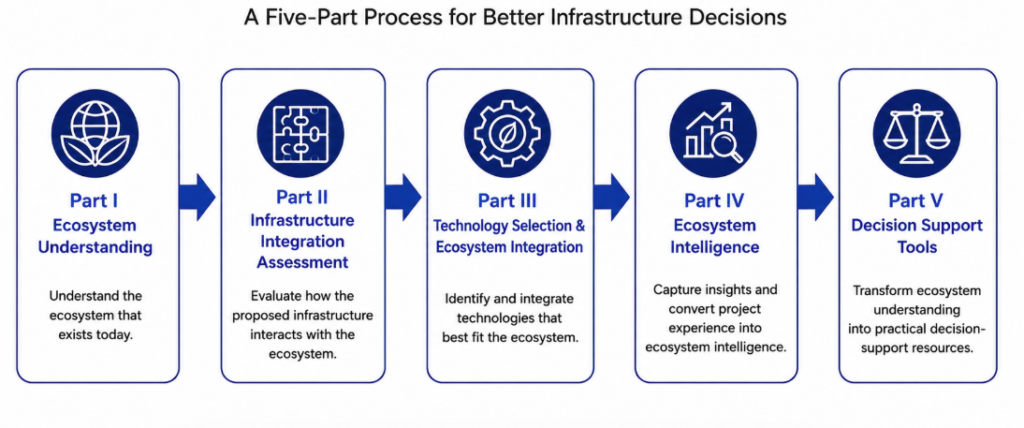
🌍 Part I – Ecosystem Understanding
Purpose & Questions
Before infrastructure decisions are made, TIIM seeks to understand the conditions that already exist and the ecosystem in which infrastructure will operate.
Questions explored
- What ecosystem exists today?
- What resources are available?
- What constraints already exist?
- Who are the stakeholders?
- What trends may influence future conditions?
Outputs
- Resource baseline
- Stakeholder landscape
- Constraint identification
- Opportunity identification
🔗 Part II – Infrastructure Integration Assessment
Purpose & Questions
Before infrastructure decisions are made, TIIM seeks to understand how infrastructure systems interact, where dependencies exist, and how changes in one system may influence conditions across the broader ecosystem.
Questions explored
- How do infrastructure systems interact?
- Where do dependencies exist?
- What bottlenecks are emerging?
- What assumptions should be challenged?
Outputs
- Dependency mapping
- Interconnection analysis
- Constraint identification
- Scenario considerations
⚙️ Part III – Technology Selection & Ecosystem Integration
Purpose & Questions
Before technologies are selected, TIIM seeks to identify and evaluate solutions that best fit the ecosystem by considering resource availability, system interdependencies, operational requirements, and long-term implications.
Questions explored
- Which technologies best fit the ecosystem?
- How do resource constraints influence technology selection?
- What infrastructure changes are required?
- What interdependencies and trade-offs emerge?
- How do technology choices influence long-term outcomes?
Outputs
- Technology suitability assessments
- Resource alignment considerations
- Integration opportunities
- Trade-off evaluations
- Preliminary implementation pathways
📈 Part IV – Ecosystem Intelligence
Purpose & Questions
Before lessons are lost to individual projects, TIIM seeks to capture observations, emerging trends, and recurring patterns that can improve future infrastructure planning and decision-making.
Questions explored
- What recurring themes are emerging?
- What new risks and opportunities are becoming visible?
- Which assumptions should be challenged?
- What lessons should be captured and shared?
- How can ecosystem insights inform future decisions?
Outputs
- Recurring ecosystem themes
- Emerging opportunities
- Risk indicators
- Knowledge resources
- Decision-support insights
🎯 Part V – Decision Support Tools
Purpose & Questions
Before major investments and long-term commitments are made, TIIM seeks to transform ecosystem understanding and accumulated intelligence into practical resources that support more informed, transparent, and resilient infrastructure decisions.
Questions explored
- How can ecosystem insights be transformed into practical tools?
- What frameworks are needed to evaluate alternatives and trade-offs?
- How can potential outcomes and risks be better understood?
- What information supports more transparent and resilient decisions?
- How can ecosystem knowledge improve future planning and investments?
Outputs
- Evaluation frameworks
- Decision-support models
- Planning templates
- Scenario analyses
- Best-practice guidance