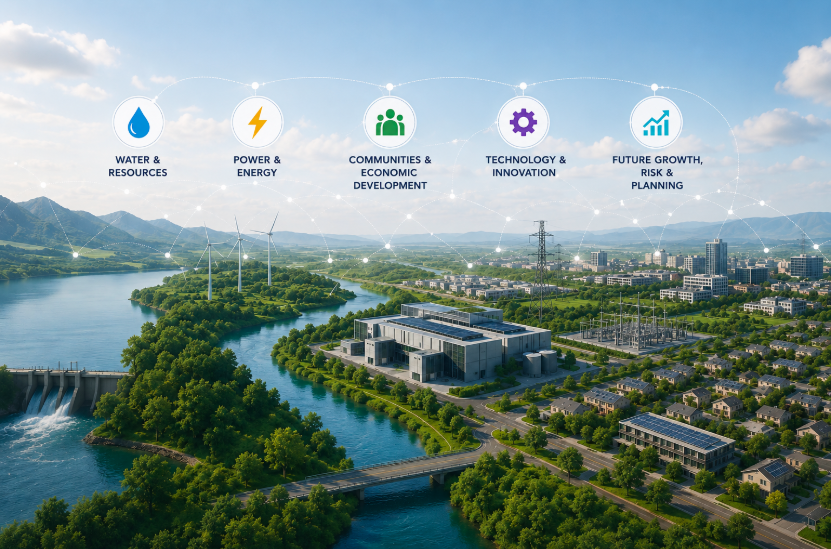
Real-World Examples of Ecosystem-Centered Thinking
The examples below illustrate situations where broader stakeholder engagement, resource forecasting, infrastructure planning, or systems-level thinking contributed to improved outcomes.
These examples are not presented as endorsements or prescriptive solutions. Rather, they demonstrate how expanding the conversation can help identify opportunities, manage tradeoffs, and improve long-term outcomes.
💧 Water & Resource Systems
Technology Selection Driven by Resource Constraints
Key Point
Water availability is increasingly influencing site selection, technology selection, and infrastructure design.
Why It Matters
Technology choices cannot be evaluated separately from the resources required to operate them.
TIIM Question
What technologies fit within the resource envelope of the ecosystem?
Ecosystem Lens
Water constraints, drought risk, future resource availability, and infrastructure resilience should help define the design envelope before technology decisions are finalized. better outcomes when ecosystem realities define the design envelope rather than the other way around.
Learn More
- Constrained Water Resources and Industrial Site Selection
https://info.siteselectiongroup.com/blog/constrained-water-resources-and-their-impact-on-industrial-site-selection - The Impact of Water Scarcity on Industrial Operations
https://blog.se.com/industry/2025/04/02/the-impact-of-water-scarcity-on-industrial-operations/ - Nature Communications – Economic Impacts of Water Scarcity
https://www.nature.com/articles/s41467-021-22194-0
⚡ Power & Energy Systems
Planning Beyond Current Resource Conditions
Key Point
Historic demand assumptions are becoming insufficient as AI, electrification, and industrial growth accelerate infrastructure needs.
Why It Matters
Infrastructure projects are often designed using assumptions that may no longer be valid when facilities become operational.
TIIM Question
Can existing infrastructure support projected growth and future demand?
Ecosystem Lens
Infrastructure planning may benefit from evaluating future growth scenarios, resource constraints, and alternative pathways before long-term investments are made.
Learn More
- Sandia National Laboratories – Load Growth Drivers & Resource Planning
https://www.sandia.gov/app/uploads/sites/273/dlm_uploads/2025/07/Sandia-Report_Load-Growth-Drivers_June-2025.pdf - ESIG Integrated Planning Guidebook
https://www.esig.energy/wp-content/uploads/2025/06/ESIG-IP-Guidebook-report-2025.pdf - RMI – Rewiring Utility Planning for the Age of Rapid Load Growth
https://rmi.org/rewiring-utility-planning-for-the-age-of-rapid-load-growth/
🏙️ Communities & Economic Development
Community Engagement Before Project Opposition
Key Point
More data center developers are moving community engagement earlier in the project lifecycle.
Why It Matters
Communities often become resistant when they feel decisions have already been made. (Ramboll)
TIIM Question
How can stakeholder engagement occur before positions become entrenched?
Ecosystem Lens
Early discussion can create transparency around water use, power demand, land use, noise, community benefits, and long-term development plans.
Learn More
- Meaningful Community Engagement for Data Center Developers
https://www.ramboll.com/en-us/insights/resilient-societies-and-liveability/meaningful-community-engagement-for-data-center-developers - How Community Engagement Can Green-Light a Data Center
https://www.clearesult.com/insights/blog-community-engagement-for-data-centers - Data Centers & the Art of Being a Good Neighbor
https://www.greshamsmith.com/news-and-insights/data-centers-the-art-of-being-a-good-neighbor-ten-steps-for-better-community-engagement/ - Brookings – Why Community Benefit Agreements Are Necessary for Data Centers
https://www.brookings.edu/articles/why-community-benefit-agreements-are-necessary-for-data-centers/
World Resources Institute – 7 Ways Data Centers Affect U.S. Communities
https://www.wri.org/insights/us-data-center-growth-impacts
JLL – How Data Centers Transform and Engage with Local Communities
https://www.jll.com/en-us/guides/how-data-centers-transform-and-engage-with-local-communities
⚙️ Technology & Innovation
Designing Technology Around Ecosystem Realities
Key Point
Emerging infrastructure technologies increasingly require evaluation within the constraints of water availability, energy resources, and long-term resilience considerations.
Why It Matters
Technology decisions that are made independently of ecosystem realities may create unintended constraints and tradeoffs.
TIIM Question
Which technologies best fit within the ecosystem’s resource envelope?
Ecosystem Lens
Technology selection may produce better outcomes when ecosystem realities define the design envelope rather than the other way around.
Learn More
- Metal-Organic Frameworks (MOFs) in Atmospheric Water Harvesting
https://yaghi.berkeley.edu/pdfPublications/20MOFWaterHarvester.pdf - 3 Key Applications Driving Growth in Metal-Organic Frameworks (MOFs)
https://www.idtechex.com/en/research-article/3-key-applications-to-drive-50-fold-growth-in-mof-demand-by-2030/33533 - Future of Power Systems – Behind-the-Meter (BTM) Generation
https://initiatives.weforum.org/future-power-system/case-study-details/behind-the-meter/aJYTG00000012ML4AY
📈 Future Growth, Risk & Planning
Planning Beyond Current Resource Conditions
Key Point
Rapid growth can outpace planning assumptions, creating infrastructure constraints that are difficult to address once projects are underway.
Why It Matters
Infrastructure decisions frequently have multi-decade consequences and therefore require consideration of future conditions rather than only current conditions.
TIIM Question
How can future conditions improve infrastructure decisions today?
Ecosystem Lens
Evaluating future demand, emerging risks, and alternative scenarios may improve visibility into constraints and opportunities that are not yet apparent.
Learn More
- Sandia National Laboratories – A Review of Load Growth Drivers & Associated Resource Planning Activities https://www.sandia.gov/app/uploads/sites/273/dlm_uploads/2025/07/Sandia-Report_Load-Growth-Drivers_June-2025.pdf
- ESIG – Integrated Planning Guidebook: A Practical Coordination Framework for Electricity Planners https://www.esig.energy/wp-content/uploads/2025/06/v2-ESIG-IP-Guidebook-report-2025.pdf
- RMI – Rewiring Utility Planning for the Age of Rapid Load Growth https://rmi.org/rewiring-utility-planning-for-the-age-of-rapid-load-growth/ (If this specific article URL changes, RMI’s Insights page remains the authoritative source for their work on utility planning and rapid load growth.)